Uno Blueprint
0 → 1 internal tool making a complex service understandable to both people and AI
- Company
 PLUS
PLUS
About
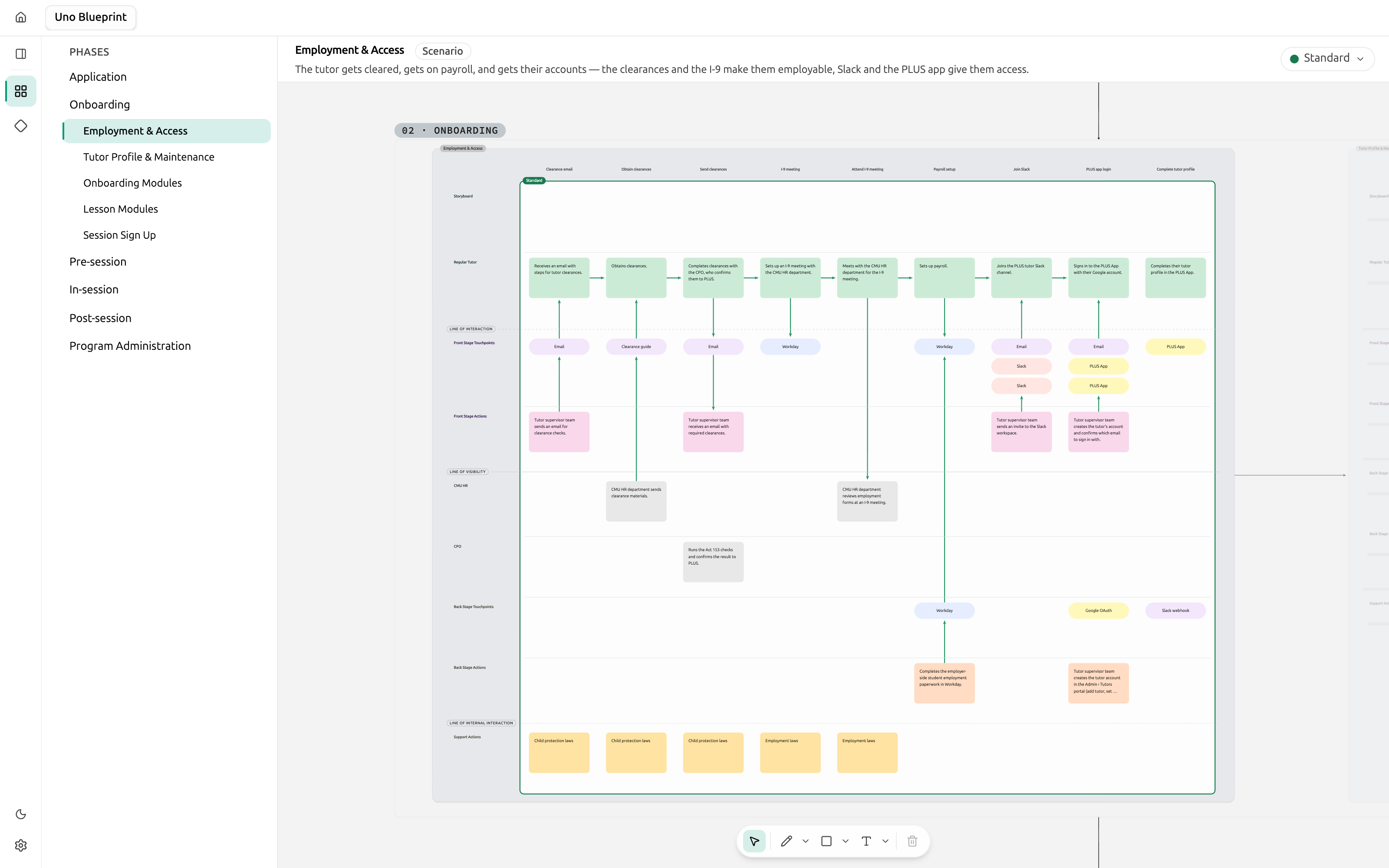
PLUS Personalized Learning is a hybrid human-AI tutoring platform with 900+ tutors, used across 25+ schools, supporting 8,900+ middle school students through real-time, in-class math tutoring sessions. As the service grew, knowledge about how it worked became fragmented across documentation, designs, and individual teams. This made it difficult for people to understand how individual product experiences fit into the larger service, and leaving AI agents without the structured context needed to reason accurately about it.
As a result, Uno Blueprint was created as an interactive source of truth that makes the service easier for both people and AI agents to understand and navigate.
+170%
increase with Uno Blueprint as contextin comparison with product documents.
Project Artifacts
- Uno Blueprint App
- Marketing Website
- Product Template & Agentic Skills
- Context Engineering Article
Context
At PLUS, three things were happening at once.
- AI agents are functioning as team members.
- More part-time contributors are joining the team.
- The service experience documentation is out of spec.
The problem
No shared source of truth on the service PLUS delivers.
Without that context, people could only see their slice of the service. Agents could not reason about the experience. Neither knew what PLUS actually delivers to students, tutors, and schools.
Research
To design a solution for the problem, we set out to understand how to represent a service to people, and how to provide context to an AI agent.
How do we represent a service to people?
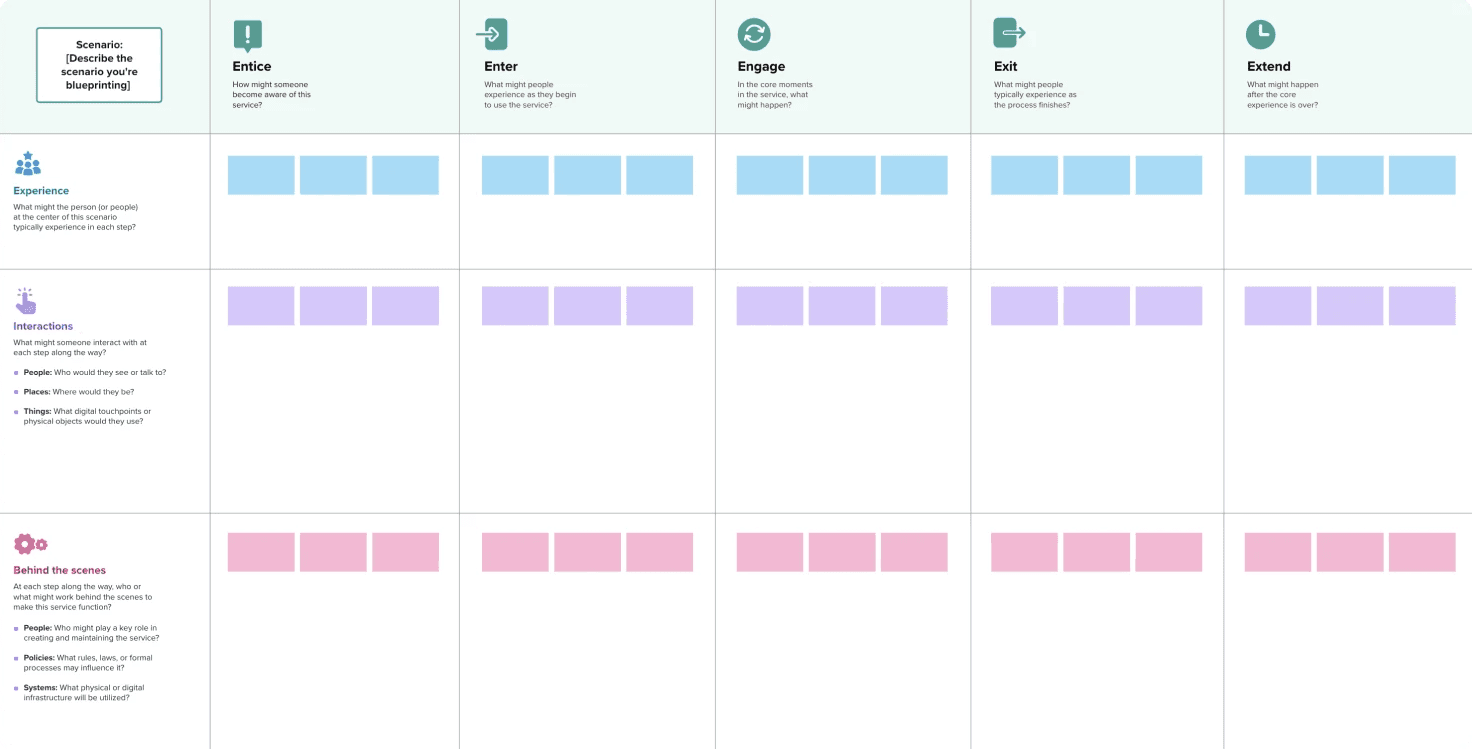
Service design is the work of planning how an organization delivers an experience. It organizes the people, processes, and systems involved, both in front of the customer and behind the scenes, so the service holds together as one thing.
A service blueprint is the diagram for that work. It maps who does what over time, and how visible moments depend on backstage work and supporting systems.
Pros
- Makes the whole service visible.
- Gives teams a shared language.
Cons
- A complex service is hard to represent as a PDF or a picture.
- It falls out of date, and has to be updated as the service changes.
How do we give a model the context it needs to act?
Context engineering is about what the model knows when it acts. That includes what it can look up, what it remembers, and what structured knowledge it can draw on. So when teams need to give an agent more context, they often reach for what already exists: markdown files like design.md, Notion pages, product docs, or internal knowledge bases.
Pros
- Fast to write and share.
- Models can reason from prose.
Cons
- The context tends to be unstructured.
- The context does not include the end to end service experience.
“How might we create a shared source of truth that people and AI can both understand?”
Strategy
Turn the blueprint into an interactive tool, where the app itself is for human exploration and the backend database is for agent context.
People
- Navigate the service
- Create focused slices
- Inspect the details
- Explore with an AI agent
- Annotate and collaborate
Agents
- Structure
- Map
- Slice
- Audit
- What-if
Uno Blueprint
Shared service model
Solution
Uno Blueprint, an internal tool that makes a complex service understandable to both people and AI.
Uno Blueprint turns a traditionally dense service blueprint into an interactive tool that helps team members navigate the service, focus on what matters, and work with the blueprint in different ways.
Preview coming soon
01
Navigate the service
Move from the larger system into phases, scenarios, paths, and moments without losing context.
Scroll to continue
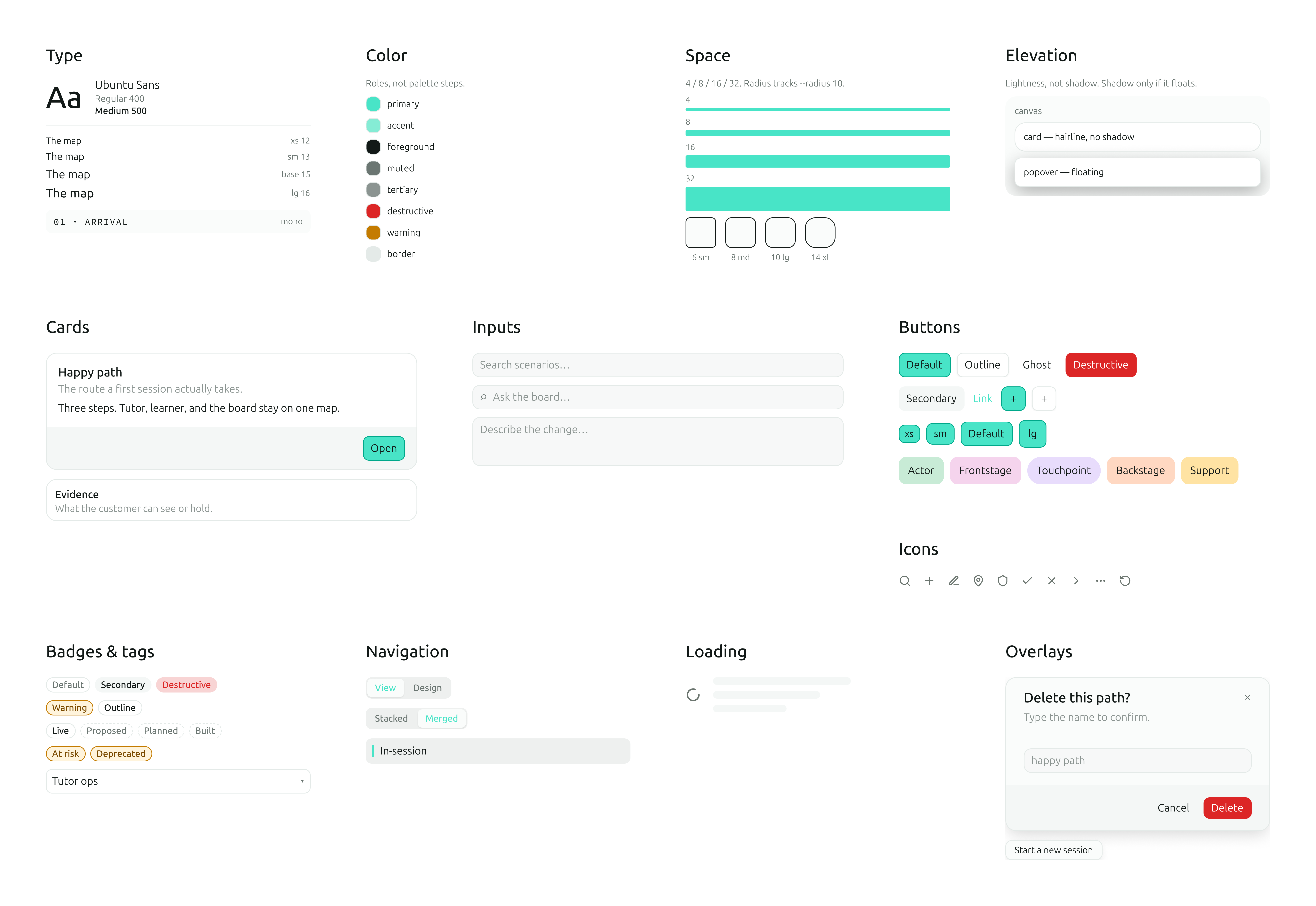
Design System
Impact
Did Uno Blueprint make AI responses more accurate?
+170%
increase with Uno Blueprint as contextin comparison with product documents.
Finding 01
Structure beat scattered documents
The blueprint helped the AI find the right context instead of piecing together information across disconnected documents.
Finding 02
More context wasn’t always better
Outdated or conflicting documents could make the AI confidently wrong. Adding more information did not automatically improve accuracy.
Finding 03
AI needed rules for using context
When sources disagreed, the AI needed guidance on what to trust, when to supplement the blueprint, and when to flag a conflict.
TLDR
Good AI context needs both structure and rules for how that structure should be used.
Beyond PLUS
What started inside PLUS became something more general.
PLUS became the proving ground for a broader idea. The underlying architecture isn’t inherently about tutoring. Any organization operating a complex service could represent people, processes, technology, and interactions through the same model.
Marketing site
I designed the marketing experience for the generalized product, so other teams could quickly understand the value proposition.
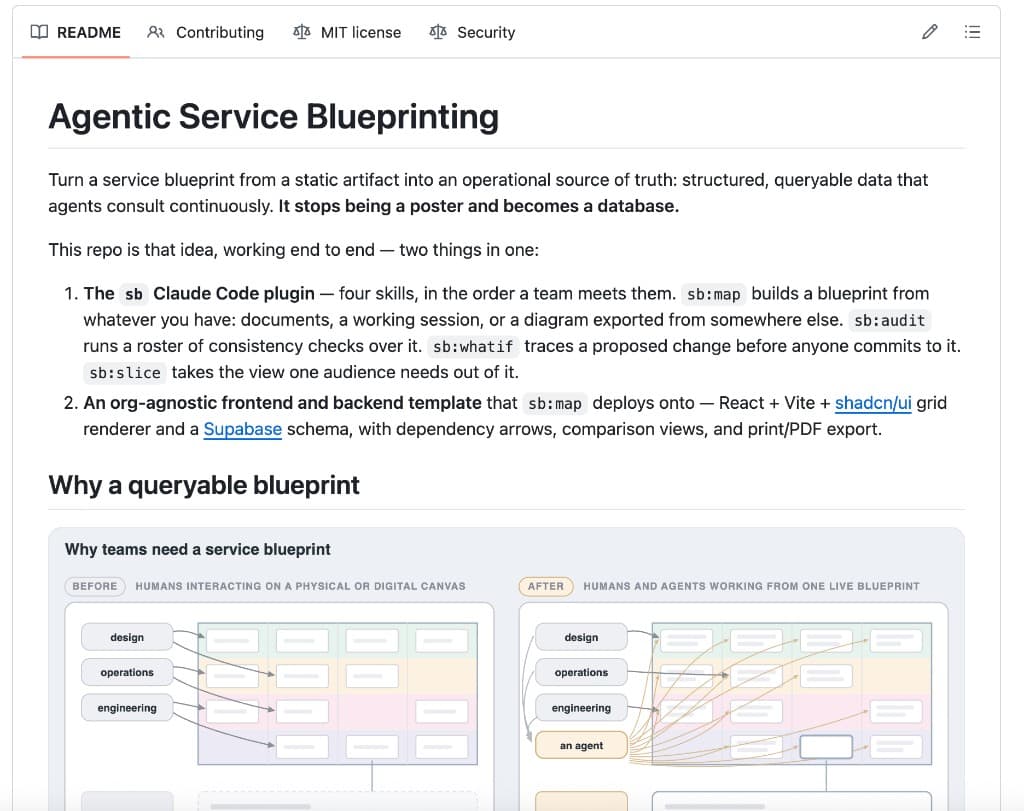
Reusable Template & Agentic skills
Teams can adapt the architecture to model their own service, with agent-facing skills for retrieving and reasoning with the same model.
Article
Service Design Is the Missing Layer in AI Context Engineering.
Learnings
AI is becoming another user of digital products.
MCPs allow AI agents to access and interact with products directly. This changed how I thought about the user of the system. I wasn’t only designing how people navigate information, but also how an AI agent finds, understands, and uses that same information.
Vibe coding works better with specificity.
Trying to build everything at once produced weaker results. Clear briefs, smaller iterations, and evaluating what I built by actually using it led to much stronger outcomes.
Easier to look at isn’t always easier to understand.
Splitting a complex system into simpler screens could make each view feel cleaner, but it could also hide how things connect. I designed for focus without losing the larger context.